


You can't buy a dental practice alone. Learn the three essential team members: dental buyer's advisor, dental-specific CPA, and dental-specific transaction attorney. Plus timing for entity formation.
If you're thinking about buying a dental practice by yourself, stop. I've never seen that work. The ones who try it end up overpaying, missing red flags, or getting tangled up in legal issues that cost them way more than they saved.
Buying a practice is complex. There are financials to review, negotiations to navigate, legal documents to understand, and a hundred details that can go wrong. You need a team. The good news is you don't need a huge team. Three people. That's it. These are the three essential roles.
Role 1: A Dental Buyer's Advisor (Someone Like Me)
This is your counterbalance to the seller's broker. The seller has someone in their corner fighting for their interests. You need someone in yours who understands dental practices.
You want someone who has real experience evaluating dental practices and understands the clinical and financial side of the business. Not just someone who reads about practice sales, but someone who has been through the process and knows what to look for.
What they do: they help you evaluate whether a practice is worth buying. They look at the numbers and tell you the truth about what you're looking at. They negotiate alongside you or for you. They spot the red flags that dentists with tunnel vision miss. They've looked at hundreds of practices, so they know what normal looks like and what's a warning sign.
I've evaluated over 500 practices. Only 15-20% of them were worth buying. I help my clients be in that group of buyers who get decent deals on practices that actually make sense. That's the value of someone who does this day in and day out.
Role 2: A Dental-Specific CPA
Not a general accountant. Not your cousin who does taxes. Someone who specifically works with dental practices and understands the business.
When you're looking at a practice's financials, you need someone who can read between the lines. A general CPA might look at a P&L and see that a practice does $1 million in revenue. A dental CPA looks at the same P&L and sees $1 million in revenue but also that the overhead is suspiciously low and there's likely a payroll issue or a spouse on the books who isn't actually working there.
What they do: they review the financials thoroughly. They do an overhead analysis. They look at where money's coming from, where it's going, and whether those numbers actually make sense for that type of practice. They catch the manipulated books before you sign the LOI.
Timing matters here. Don't engage your CPA until a few weeks after signing the LOI. Why? Because you don't want to pay them to review every single practice you're interested in. That gets expensive fast. Once you've got an LOI signed, you've got real due diligence to do, and that's when you bring your CPA in to do a deep dive.
Role 3: A Dental-Specific Transaction Attorney
This is non-negotiable. You need someone who specializes in dental practice transitions. Not a general commercial attorney. Not the broker's recommended attorney. Your own attorney who specializes in dental deals.
Why does it have to be dental-specific? Because dental transitions have unique issues. Patient records and HIPAA compliance, DEA registrations, state dental board license issues, CE requirements, lease assumptions in a specialty practice versus a general practice. These are things a general attorney doesn't think about automatically.
What they do: they structure the deal properly, review all the legal documents, make sure you're protected in the purchase agreement, and handle the closing logistics. They also help you understand what you're actually committing to when you sign something.
Cost is usually a flat fee, somewhere in the $10,000 to $13,000 range for a typical practice transition. That's a reasonable investment to make sure you don't accidentally commit to something that buries you.
Do not use an attorney the broker recommends. That attorney has a relationship with the broker and the broker sends them business. They're not thinking about what's best for you. They're thinking about closing the deal. Find your own attorney who specializes in dental practice acquisitions.
The Team Lineup
So you've got three people: a dental buyer's advisor, a dental CPA, and a dental transaction attorney. You meet with them before you start looking seriously. You tell them what you're looking for. You go through the process together. When you find a practice, they all have eyes on it. When you're negotiating, they're advising you. When you're closing, they're handling their piece.
This isn't overhead. This is insurance. The difference between a good deal and a bad deal on a $500K practice acquisition is often $50K to $150K. Your team pays for itself.
Entity Formation Timing
One more thing that comes up: when should you form your LLC for the practice?
Don't do it too early. A lot of people want to get their entity set up before they even have an LOI signed. That's premature. You don't need it until you're serious about a specific practice.
Usually, you form your entity after signing the LOI, a few weeks in. That gives you time to make sure the deal is actually going to work. By then you've got financing pre-approval, you've started due diligence, and you know this isn't just window shopping.
Your attorney will handle the entity formation. It's straightforward and takes a couple weeks to file everything properly.
You Can't Do This Alone
I say this from experience. The dentists who try to cut corners on their team end up paying for it. Either they buy a bad practice and regret it for years, or they miss something in the legal documents that costs them money, or they don't understand what they're actually buying until it's too late.
Build your team before you start looking. Interview these people. Make sure they understand what you're trying to do and that they're the right fit. Then trust them to do their job. That's how you buy right.
Practice Evaluation & Advisory Service
Independent clinical and financial analysis to help you make an informed decision before you buy.
Learn more
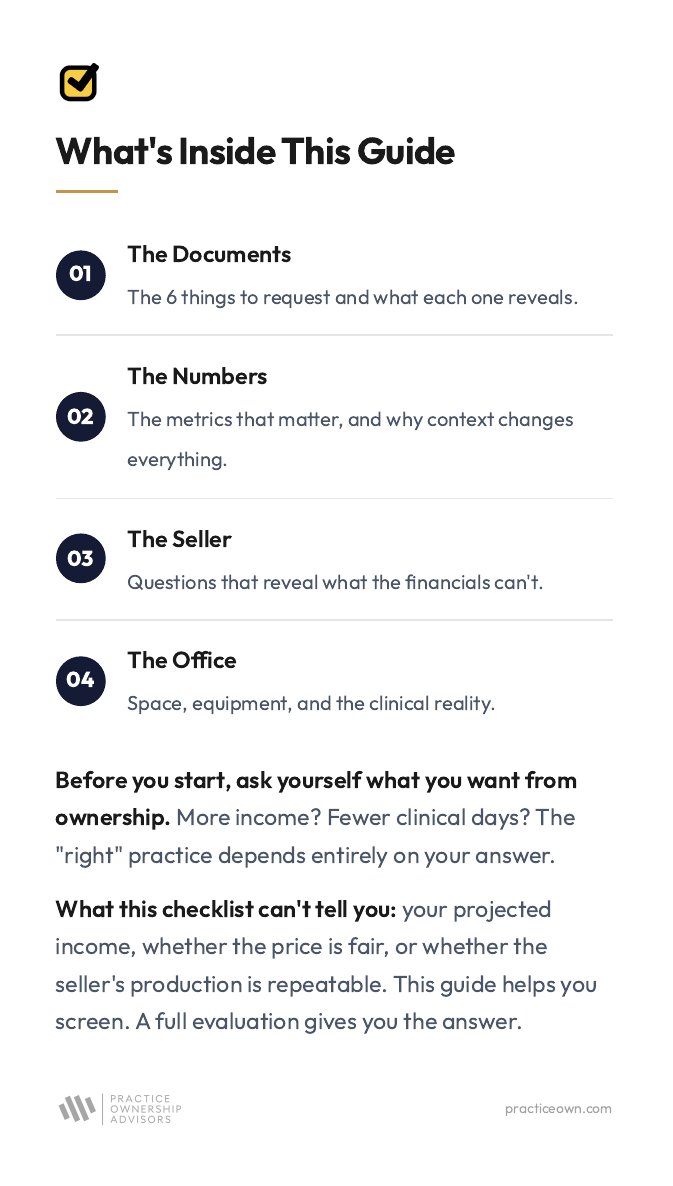

Newsletter + Free Practice Evaluation Checklist
One useful email per week on buying the right practice, plus an instant download of our free Practice Evaluation Checklist.
One email per week. Checklist delivered instantly. Unsubscribe anytime.