


The key criteria I use to evaluate dental practices for acquisition. These are the fundamentals that determine whether a practice will actually get you where you want to be financially.
When I'm evaluating a dental practice for a potential buyer, there are a lot more than seven things I look at. But there are a handful of fundamentals that I come back to every single time. If a practice doesn't check most of these boxes, I'm going to tell you it's probably not worth pursuing, no matter how good the spreadsheet looks.
I've looked at hundreds of practices. Some of them had beautiful numbers but weak fundamentals. Others looked mediocre on paper but were solid opportunities because they had the right patient base and the right team. These are the things I've learned matter most.
1. How Many Active Recall Patients
This is the foundation. You make your money by producing on patients. That means you need patients in the chair, and specifically, you need recall patients: the ones who come back every six months for cleanings and exams. They're the ones who generate treatment plans, restorative work, and referrals. They're the engine of the practice.
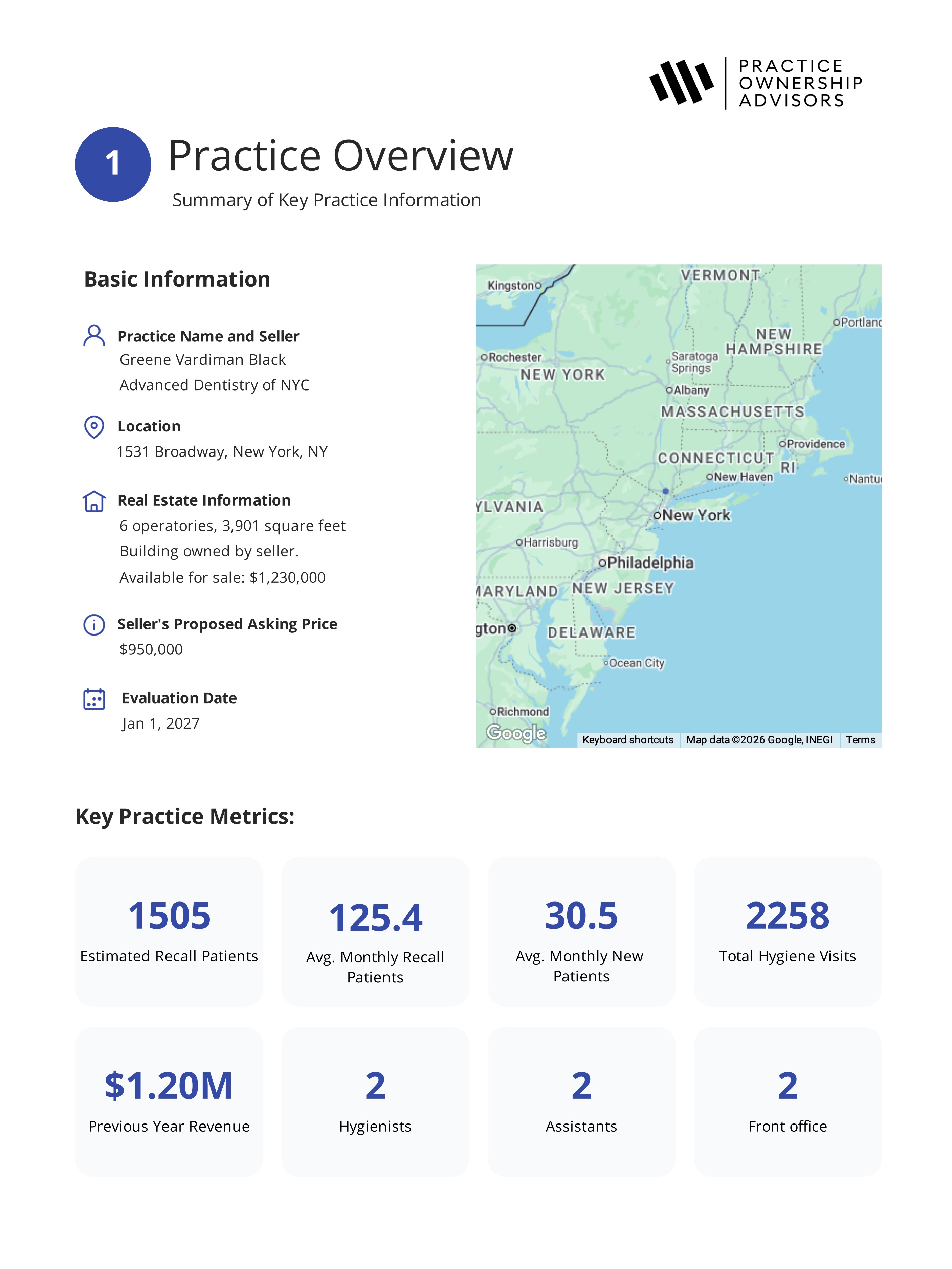
I want to see at least 2,000 active recall patients. Not appointments per year. Not active files. Active recall patients who actually show up. If a practice only has 800 active recall patients, that may not be enough to reach your financial goals, no matter what the production numbers say.
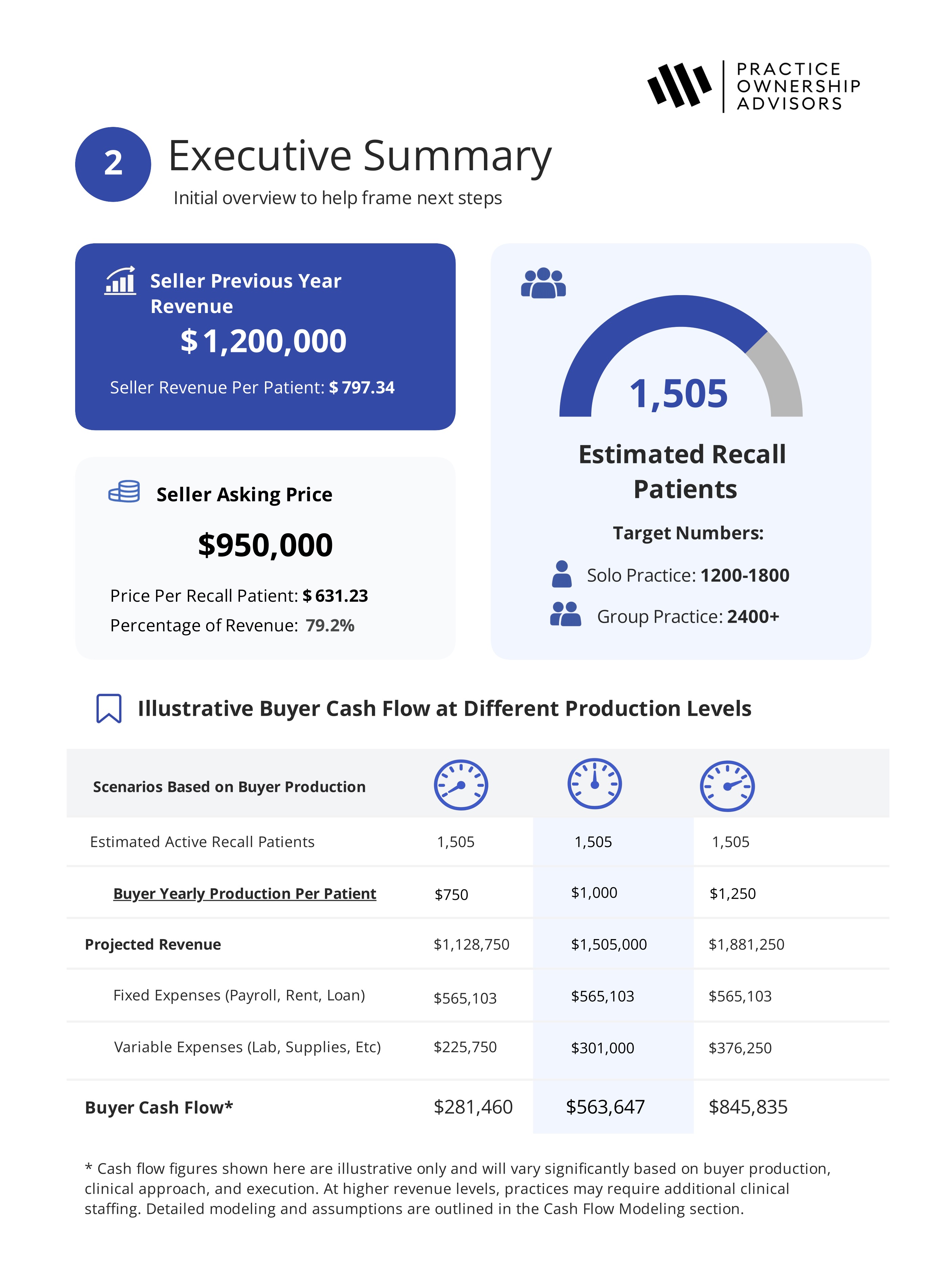
A good recall patient is worth $1,000 to $1,500 in annual revenue. A patient base of 1,500 active patients represents $1.5 to $2.25 million in annual revenue potential. Even if the practice is currently producing $900,000, you know there's room to grow if the patients are there.
The seller might have slowed down clinically. They might have cut back their schedule. But those patients are still there. That's what you're really buying.
2. Low Production Per Patient
Brokers often steer buyers toward high-production practices because those sell for more money. But high production per patient isn't necessarily what you want.
If a practice is doing $3 million annually with a small patient base, that seller has already maximized the treatment on those patients. They've done the crowns, the implants, the complex cases. The practice is fully optimized. When you take over, there's nowhere to go but sideways or down.
What I want to see is revenue per patient around $600 to $900 per year. That means there's untreated dentistry. It means there's room to grow. You'll see x-rays with crowns that should have been replaced, decay that hasn't been addressed, perio patients who haven't had definitive treatment.
A practice with 1,500 patients at $600 per patient is $900,000 in revenue. But it's also $450,000 or more in unrealized treatment potential. That's where your income growth comes from.
3. Seller Referring Out Procedures
If the seller has been referring out implants, complex perio, or prostho cases, that's a good sign. It means the patient base needs that care but has been going somewhere else to get it. If you have those skills, you can bring that revenue in-house.
Let's say the practice is referring out $5,000 per month in implant cases. Over a year, that's $60,000 in production leaving the practice. If you can capture even half of that, you're looking at meaningful revenue growth from day one.
This is solid fundamentals. A practice where the seller had clear clinical limitations but still maintained good referral relationships tells you the demand is there. The patients wanted the care. They just had to go somewhere else for it.
4. An Experienced Office Manager and Stable Team
Having an office manager who knows the systems is invaluable. The office manager runs the day-to-day operations: scheduling, billing, insurance, patient communication. Hiring and training a new office manager takes months, and during that time everything suffers. If the practice already has one who knows how things work, that's a huge advantage.
Hygienists with established patient relationships are also extremely valuable. A lot of patients will come back specifically to see their hygienist. Those relationships drive retention through the ownership transition in a way that nothing else can.
That doesn't mean a practice with some newer team members has no value. But the core people, the office manager and the hygienists, make a real difference in how smoothly the transition goes and how much of the patient base stays.
5. At Least Two Hygienists
If you're looking at a practice that doesn't have a hygienist, just keep looking. You need at least one hygienist, and ideally two or three.
Here's the math. Most hygienists can see about 800 patients per year. If your goal is to have 1,500 to 2,000 active recall patients, you're going to need two to two and a half hygienists to keep up with that volume. One hygienist is a bottleneck that limits your growth and creates fragility in your schedule.
Hygiene is also the most profitable department in a dental practice. It's recurring revenue. A strong hygiene program is the backbone of everything else you do.
6. Be Careful with HMO and Medicaid Practices
This is not a controversial opinion. Everyone in the industry knows that HMO and Medicaid plans pay poorly, add significant administrative burden, and create a situation where you're constantly busy but never profitable. If a practice is built primarily on HMO or Medicaid volume, you need to be very careful about whether the numbers are going to work for you after debt service.
A healthy insurance mix with a strong PPO base gives you reasonable reimbursement rates, manageable administration, and predictable revenue. That's what I want to see.
7. Be Careful with Cash-Only and High Fee-for-Service Practices
This one is a little more nuanced. A practice that operates mostly out of network or cash-only can look incredible on paper. The fees are higher, the margins are better, and the P&L is beautiful. But there's a hidden risk that a lot of buyers don't think about.
Those patients are paying more than they'd pay at the practice across the street. They know that. They stay because they've built a relationship with their dentist over 10 or 20 years. The dentist has earned that relational capital over a long time.
When you buy the practice, you don't inherit that relational capital. You're a new face asking patients to keep paying premium prices. Some will stay and give you a chance. But many will start wondering why they're paying double when there's an in-network provider down the road.
That puts you in a tough spot. Do you lower your fee schedule? Do you start going in-network with insurance companies, which drops your fees across the board? Either way, the revenue you thought you were buying may not be the revenue you actually get.
I'm not saying don't buy a fee-for-service practice. But you have to be extra careful with how you plan the transition, because patient attrition can be significantly higher than with an in-network practice. Factor that into your projections.
8. A Location You Want to Be in for the Next 20 Years
This one isn't about numbers. It's about your life.
You're going to spend the next decade or longer in this location. You're going to build a business, build relationships, maybe raise a family. Don't buy a practice in a city you don't want to be in just because the numbers are good.
When you own your own practice, patients feel your energy. Your team feels it. If you're miserable, it shows. Buy a practice where you actually want to live and work.
Not every practice will hit all seven. Sometimes there's something special about a practice that doesn't check every box. But when I'm advising buyers, I'm going back to this list every single time. These are the fundamentals that separate a practice worth buying from one that looks good but isn't.

Practice Evaluation & Advisory Service
Independent clinical and financial analysis to help you make an informed decision before you buy.
Learn more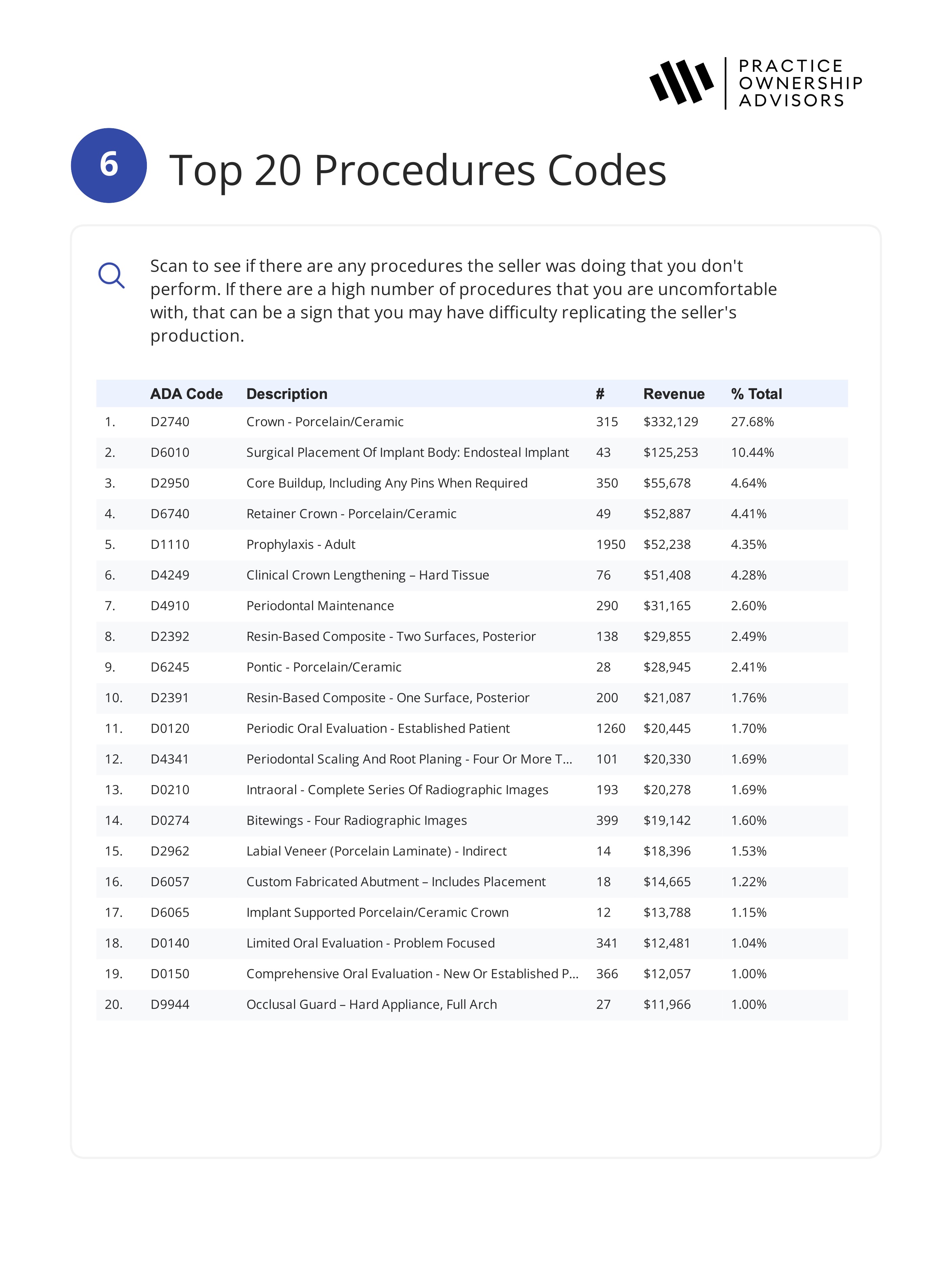

Newsletter + Free Practice Evaluation Checklist
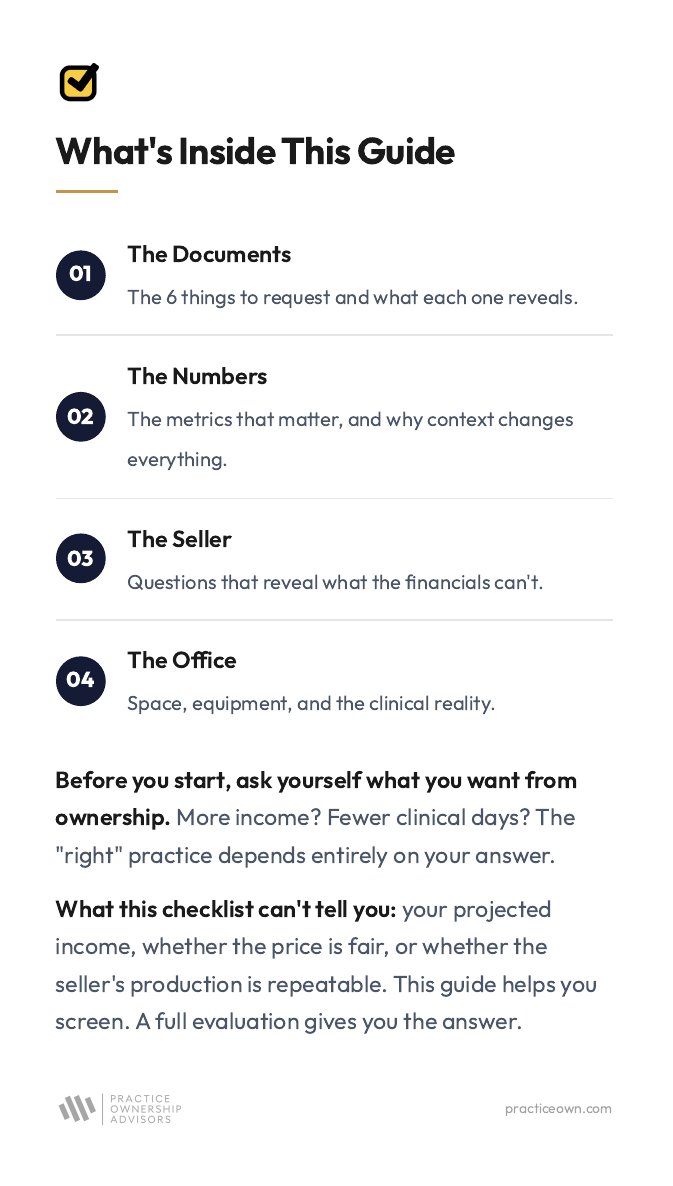
One useful email per week on buying the right practice, plus an instant download of our free Practice Evaluation Checklist.
One email per week. Checklist delivered instantly. Unsubscribe anytime.