


The four documents you need to initially screen a dental practice before committing time and resources to full due diligence.
Before you commit serious time and resources to evaluating a dental practice, you need to do an initial screening. This is not full due diligence. This is the starting point. You need four documents. That's it. These four will tell you whether a practice is worth looking at more closely.
I want to be clear upfront: what I'm describing here is just the beginning. There are many more steps required to actually do full due diligence and verification of these types of opportunities. This is simply a starting point to help you quickly filter out practices that aren't worth your time before investing dozens of hours into a deeper evaluation.
Here are the four documents you need to get started.
Document 1: The P&L Statement (Most Recent Two Years)
This is your financial baseline. You need the practice's profit and loss statements for the last two full years. One year isn't enough. Two years shows you a trend.
What I'm looking at:
Gross Revenue: This tells you the total production. I want to see consistency or growth year-over-year. If year one is $1.1 million and year two is $900,000, that's a major decline that needs explaining.
Supplies and Lab Fees: Supplies should run about 5-7% of revenue, and lab fees another 5-10%. If supplies are significantly higher than 7%, there's waste or overstocking. If they're way lower, something's off.
Operating Expenses: This includes staff payroll, rent, utilities, marketing, everything. Overall overhead should be in the 50-65% range for a well-run practice. If it's significantly above 65%, the practice has an expense problem.
Net Income: This is what's left after all operating expenses, and in most solo practices it represents the owner's total compensation (since most owners don't pay themselves a separate W-2 salary). I want to see 35-45% net income on the P&L depending on practice size. Smaller practices might run 35%, medium practices around 40%, and larger practices 45%. If net income is under 30%, either revenue is soft or expenses are bloated, and you'll have challenges.
Red flags: Declining revenue two years in a row, net income under 30%, or supplies and lab combined over 17%.
Document 2: Production by Procedure Report
This is the report I request that brokers often don't want to pull because it tells the real story.
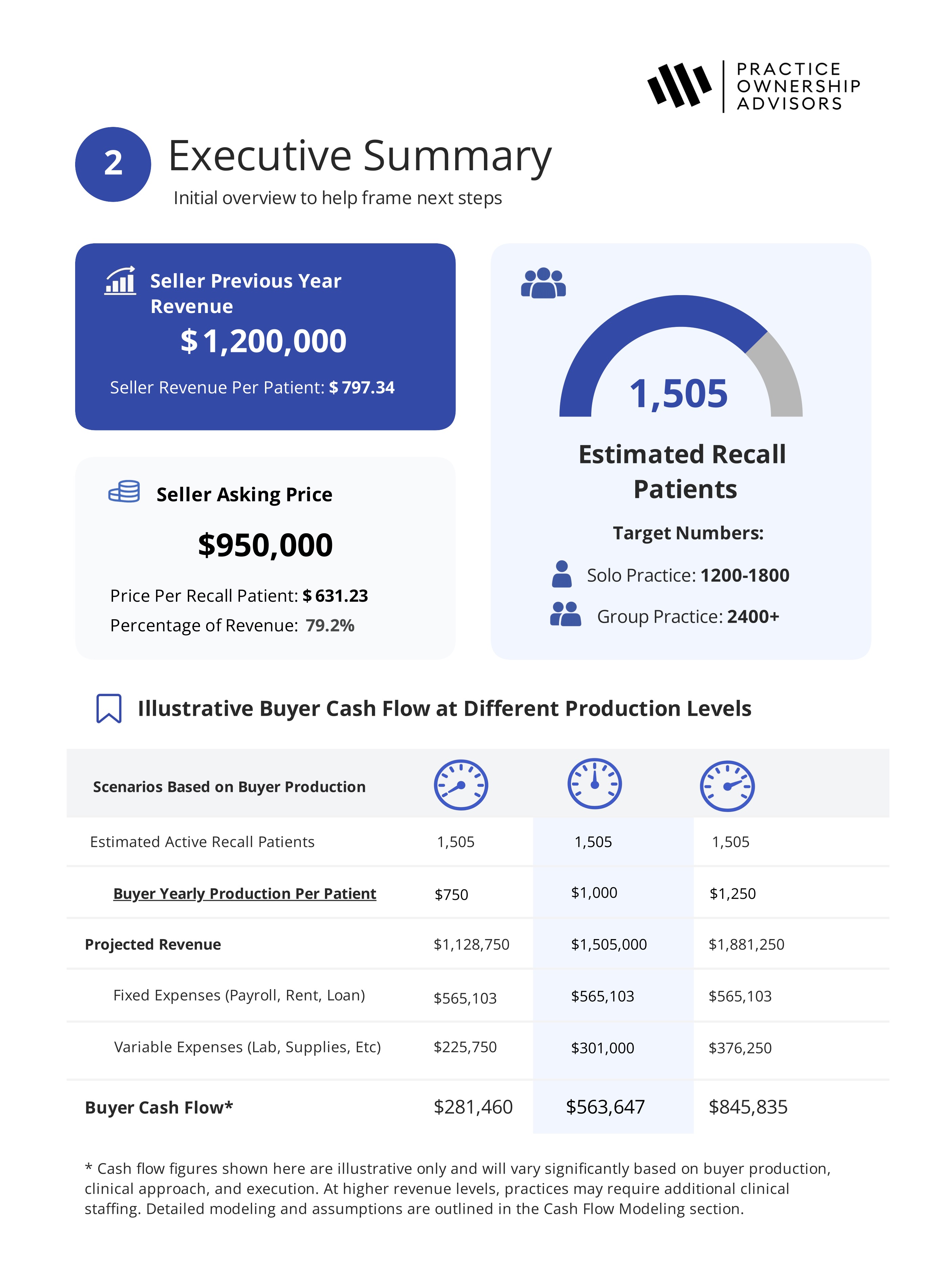
What this shows you: Which procedures generate revenue, and how much. Hygiene, restorative, prostho, ortho, implants, etc.
What I'm looking for:
Hygiene Revenue: This should be about 25-33% of total practice revenue. If it's lower, there's a hygiene problem or the hygiene team isn't there. If it's zero or near-zero because the practice doesn't report it separately, that's a red flag.
Unrealized Specialty Revenue: Are they referring out implants? Complex perio? Prostho? Look at the production mix. If you see high restorative but no complex prostho, they're referring those cases out. That's opportunity.
Procedure Distribution: A healthy practice has a mix. Not just cleanings and fillings. Crowns, implants, perio, etc. If the revenue is clustered in just one or two procedure types, there's concentration risk.
This document shows you where the money comes from and, more importantly, where it could come from if you change the clinical approach.
Document 3: Payroll Summary
This is straightforward but critical. I need to see the total payroll burden and a breakdown by position.
What I'm looking for:
Total Payroll as Percentage of Revenue: This should be under 30% of gross revenue. If it's higher, you've got an efficiency problem. Either the team is too large, overpaid, or productivity is low.
Dentist/Provider Compensation: How much is the current owner paying themselves? If it's disproportionately high relative to production, something's off. If it's artificially low, the practice is being subsidized by something (inheritance, other income).
Staff Structure: I want to see positions listed (hygienists, assistants, front desk, office manager). This tells me the team composition. Are there two hygienists or one? Is there an office manager doing dual roles?
Red flags: Total payroll over 35% of revenue, no clear staff structure, or compensation that doesn't make sense relative to practice size.
Document 4: Lease Agreement
This is the document that gets skipped but shouldn't be. The lease is critical.
What I'm evaluating:
Monthly Rent: First, is it reasonable for the market and the space? A typical dental practice should target rent at about 5% of revenue. So a $1 million practice should have rent around $50,000 per year ($4,200/month). Total facility costs (rent, utilities, maintenance) might run 5-10%, but rent alone should be around that 5% target.
Lease Term Remaining: How long is the lease? A practice with only one year left on the lease is high-risk. You might not be able to renew. I want to see at least 5-10 years remaining, or a renewal option in your favor.
Tenant Improvements: Who pays for build-out if you want to renovate? Who replaces equipment in the suite (HVAC, plumbing)? These costs can add up fast.
Assignment and Renewal Terms: Can the lease be assigned to you as the new owner? Some leases don't allow assignment without landlord approval and potential rent increases. This is a deal killer if not favorable.
Landlord Stability: Is the landlord reasonable? Is the building well-maintained? Have there been any disputes?
Red flags: Rent over 12% of revenue, less than 3 years remaining, no renewal options, landlord refusing assignment to new owner, or a history of landlord-tenant disputes.
What This Four-Document Screening Tells You
After reviewing these four documents, you'll know:
- Is the practice financially healthy?
- What's the real revenue trend?
- Where can you grow clinically?
- Is the payroll structure efficient?
- Is the location sustainable?
If the fundamentals look solid in these four documents, move to the next stage of due diligence. If they don't, don't waste your time requesting more documents.
This Is Just the Beginning
I want to reiterate: this is an initial screen, not due diligence. You are nowhere near done. Full due diligence involves tax return verification, detailed production analysis by provider, patient demographic review, equipment assessments, lease negotiation, insurance credentialing timelines, staff interviews, clinical system evaluation, and much more.
But you have to start somewhere, and this is where you start. These four documents give you the essential information to decide whether a practice deserves your time and attention for the deeper work ahead.
Most practices will eliminate themselves at this stage. That's the point. You don't want to spend 30 hours on full due diligence for a practice that has fundamental problems you could have caught in the first four documents.
The Benchmarks to Remember
If you remember nothing else from this article, remember these numbers:
- Revenue growth: Flat to 5% growth year-over-year is normal
- Net income: 35-45% is healthy
- Payroll: Under 30% of revenue
- Rent: ~5% of revenue
- Hygiene revenue: 25-33% of total
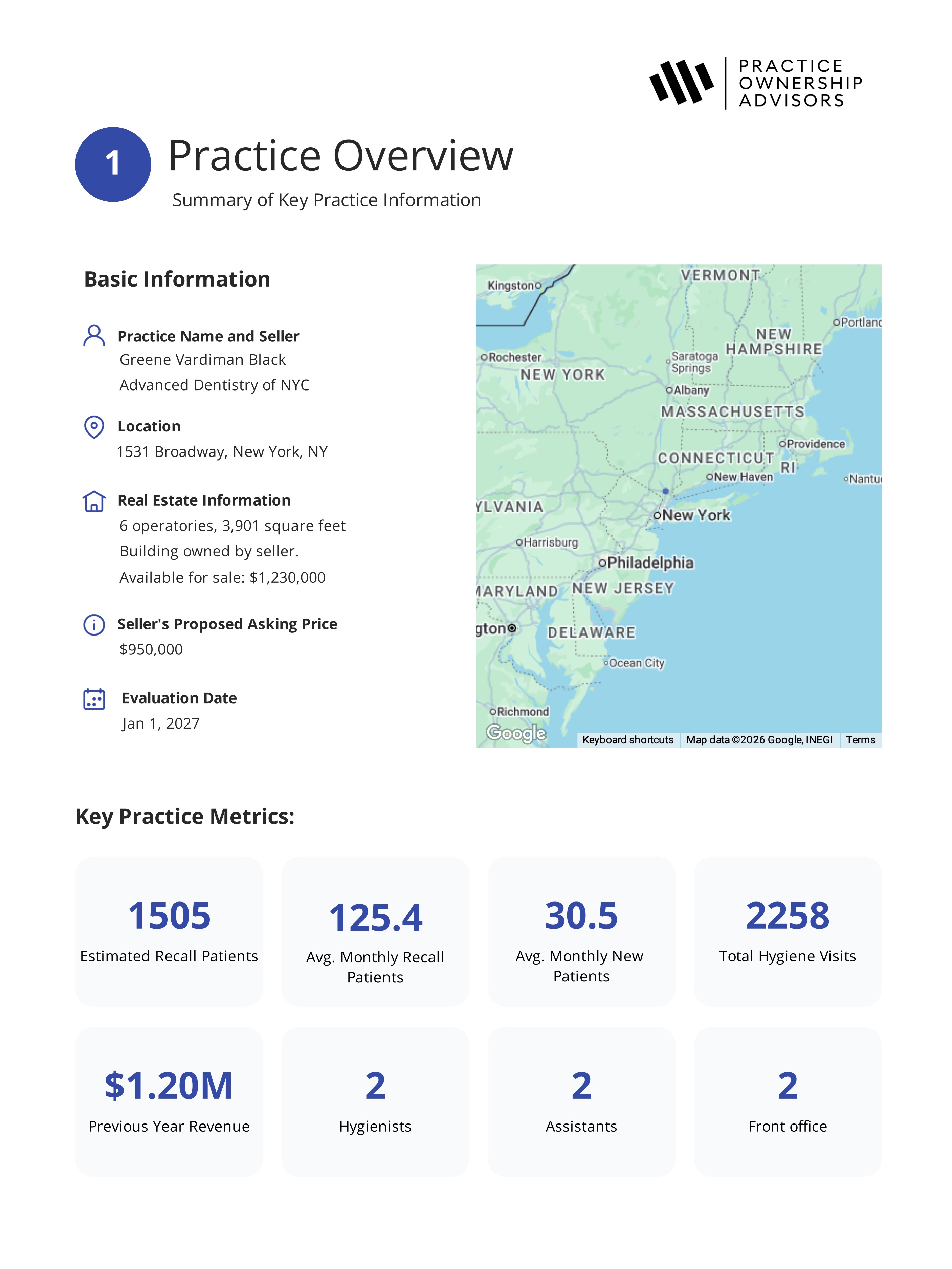
- Revenue per patient: $500-$750 below average (growth opportunity), $700-$900 average, $1,000+ above average
Run every practice against these benchmarks. If it's way off in multiple categories, keep looking.
The practices that look mediocre but hit these numbers solidly? Those are the ones worth taking to the next level of evaluation. And that next level is where the real work begins.
Practice Evaluation & Advisory Service
Independent clinical and financial analysis to help you make an informed decision before you buy.
Learn more
Newsletter + Free Practice Evaluation Checklist
One useful email per week on buying the right practice, plus an instant download of our free Practice Evaluation Checklist.
One email per week. Checklist delivered instantly. Unsubscribe anytime.