
ChatGPT told my client he would make about $56,000 a year from this practice. He made $1.1 million his first year. Here is what it missed, and how to use AI without getting burned.
One of my clients just finished his first year as a practice owner. He made $1.1 million his first year of ownership.
He almost didn't buy the practice. Before he ever called me, he ran the numbers through ChatGPT, and his CPA looked at them too. Both told him it probably wasn't a good practice and he should keep looking. He almost walked away because ChatGPT told him he would only make about $56,000 a year.
I recorded a video where I put this same practice into ChatGPT and walked through everything it got wrong. This article covers the same ground in writing. If you're planning to evaluate practices on your own with AI, read this first.
A note on the numbers: I sign an NDA every time I evaluate a practice. The figures below come from the real practice, adjusted by about 10% in the same direction to protect confidentiality. The dentist and his $1.1 million year are real.
The Practice
On paper, nothing about this office jumped out:
- About $1.2 million in collections the previous year
- Seven operatories in 2,800 square feet
- Asking price of $936,000
- Net operating income on the P&L of about $118,000
That last number is why his CPA said no. Expenses were about $1.1 million against $1.2 million in revenue. Once you add back the usual discretionary expenses, the seller was taking home somewhere around $175,000 to $200,000. That's roughly what a decent associate job pays. If you stop there, it looks like you'd be buying yourself a job and a loan.
What ChatGPT Said
I gave ChatGPT the broker's prospectus, the profit and loss statement, and the production by procedure report. I used a temporary chat with no personalization, so it had no information about me. Then I asked what I would make, whether there were red flags, and whether I should buy.
The answer looked impressive. It normalized the P&L, estimated about $178,000 in adjusted cash flow, and subtracted debt service. It assumed I would borrow 90% of the price at 8% over 10 years, about $123,000 a year in payments. That left roughly $56,000 a year for me. Its conclusion: don't buy at the asking price without a meaningful price cut.
The 8% rate was its first mistake. That's general business loan pricing. Dental-specific lenders offer much better terms.
Then it listed six red flags. If I didn't know better, that list would have scared me off too.
The Red Flags That Weren't
"Revenue appears to be drifting downward." Collections went from $1.25 million to $1.28 million to $1.23 million. That's barely a drift. And when revenue slips while the patient base holds steady, that's good for a buyer. You buy at a discount and grow it back.
"Only five new patients per month." In a 500-patient practice trying to grow, that would worry me. This office had about 3,000 patients and one doctor who was so busy he had stopped accepting new ones. Five a month is what a practice looks like when it isn't taking new patients.
"The perio numbers are bizarre." Over 4,000 adult cleanings and almost no perio maintenance. That isn't bizarre. It's an office that doesn't do perio, which is a growth opportunity for the next owner.
"Heavily dependent on restorative dentistry." The opposite was true. Nearly half of production came from hygiene, which put this office around the 89th percentile in my data. More on that below.
"Payroll is enormous" and "rent is very high." Neither held up. Both were reasonable for a practice of this size.
Its suggested upside wasn't much better. It said to add a fifth day and invest in marketing. My client did neither. A practice with 3,000 patients doesn't need marketing, and you don't need another day when the patients are already there.
It also suggested cutting expenses, which was the worst advice in the whole report. Cutting expenses means letting staff go and buying cheaper materials to save a few thousand dollars, in a practice with enormous room to grow.
The Number That Matters Most: How Many Patients
When you buy a practice, you're not really buying equipment. Equipment can be replaced. You're buying access to patients on a recall schedule. More patients means more chances to diagnose and treatment plan, and that's where your income comes from. So the first thing I estimate is the number of active patients, using more than one method.
Hygienists. A full-time hygienist sees roughly 800 patients a year. This office had three full-time hygienists, which points to about 2,400 recall patients.
Cleanings. Add up adult prophies, child prophies, and perio maintenance from the production report. Patients don't all come back every six months, so I assume one visit about every nine months. This office did about 4,500 cleanings, which works out to roughly 3,000 active patients.
Here's how I think about practice size:
- Under 1,000 patients: too small to keep a schedule full
- 1,000 to 1,600: solo practice
- 1,600 to 2,200: busy solo
- 2,300 and up: group practice size, with enough patients for a second doctor
This was a group-size practice run by one dentist. ChatGPT never mentioned it.
One of the Best Kinds of Practice to Buy
There's a type of practice I see over and over, and it's one of the best buys in dentistry. One older doctor nearing retirement. Thousands of patients. Three hygiene checks an hour. He's slowing down, so he stops treatment planning comprehensively because there isn't time to do the work. He stops taking new patients for the same reason.
That's exactly what this was. The seller was in his 70s, trying to care for 3,000 patients alone. A buyer can come in, add an associate or split the schedule, and spend real time with each patient. You can grow a practice like this dramatically without adding much expense. That's how my client roughly doubled the practice in his first year.
Where the Growth Was Hiding
I compare every practice to a database of more than 500 practices I've evaluated over the last two to three years.
Collections per patient. The median in my data is about $916 per patient per year. Cleanings, exams, and X-rays cover maybe $200 to $300 of that. This practice collected less than half the median.
Hygiene share. The median practice gets 32% of its production from hygiene. This one got 47%, the 89th percentile. The dentist was producing very little dentistry per patient.
Procedures. Compared to practices of the same size, nearly every category was low:
- Crowns: about 400, 32% below average
- Buildups: 146, 61% below average
- Bridge units: 62, 45% below average
- Fillings: about 1,000, 45% below average
- Endo: zero
- Implants: one
- Ortho cases: six
- Extractions: 45 on 3,000 patients
- Dentures and partials: nine
As a buyer, low numbers are what you want to see. When a seller is producing two or three times what a typical dentist does, it can be a sign of overdiagnosis. You'll either struggle to match it or inherit a chart where everything has already been done. When a seller has under-treated for years, the work is waiting for you. If you like endo, implants, or ortho, this office had 3,000 patients to treatment plan.
That isn't overselling. Patients come to you because they want help. The seller simply stopped doing the work, and the next owner just has to do it.
The Three Scenarios I Gave Him
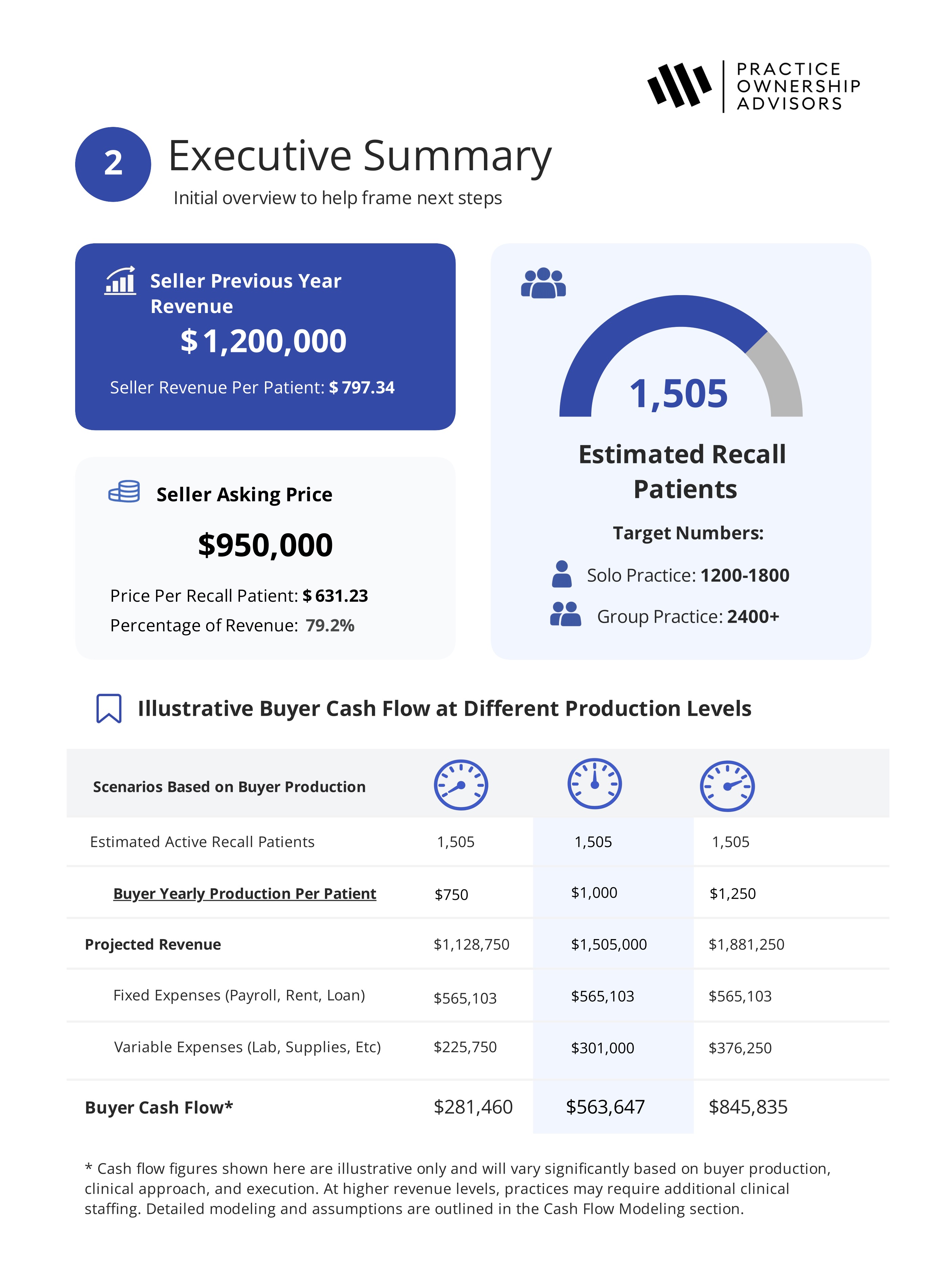
I model the buyer's take-home pay, after the practice loan payment, at different levels of production per patient:
- Conservative: about $450 per patient, roughly what the seller was doing. Take-home of about $115,000, close to what ChatGPT said.
- Moderate: $700 per patient. Take-home of about $700,000.
- Strong: $950 per patient. Take-home of about $1.3 million.
Honestly, the moderate case was too conservative, since the median in my data is about $900. I didn't want to overpromise.
He made $1.1 million his first year, right between moderate and strong. That's after paying the seller to stay on two days a week, and after a loan payment of about $134,000 a year, which is really money going toward an asset he will sell someday.
To be clear, not every client makes a million dollars in year one. The average I see is closer to $500,000 to $600,000, which still beats most associate jobs. But a year like this isn't unheard of when you buy the right practice.
Why AI Gets This Wrong
I use AI all the time. For evaluating practices, I've found it unreliable, for two reasons.
First, it doesn't have the data. Practice sales happen under NDAs. Production reports, P&Ls, and what buyers actually earned afterward never make it onto the public internet.
Second, most of what is public was written by brokers and CPAs using simple methods, like multiples of collections or profit on the tax return. Those methods measure what a practice earned for the seller, not what it can earn for you. AI learned from that material.
And it sounds completely confident while it's wrong. That's the dangerous part.
How to Use AI Without Getting Burned
- Use it to organize documents, summarize a prospectus, and draft questions for the broker.
- Don't let it value the practice or tell you whether to buy.
- Estimate the active patient count yourself, from hygienists and cleanings.
- Compare the production report to benchmarks. Low production per patient in a busy office is often opportunity, not a red flag.
- Before you walk away from a practice, or sign for one, have someone who has seen hundreds of real practices check the numbers.
Be very careful who you listen to when you're buying a practice. My client almost listened to ChatGPT and his CPA. It would have cost him close to a million dollars in his first year alone.
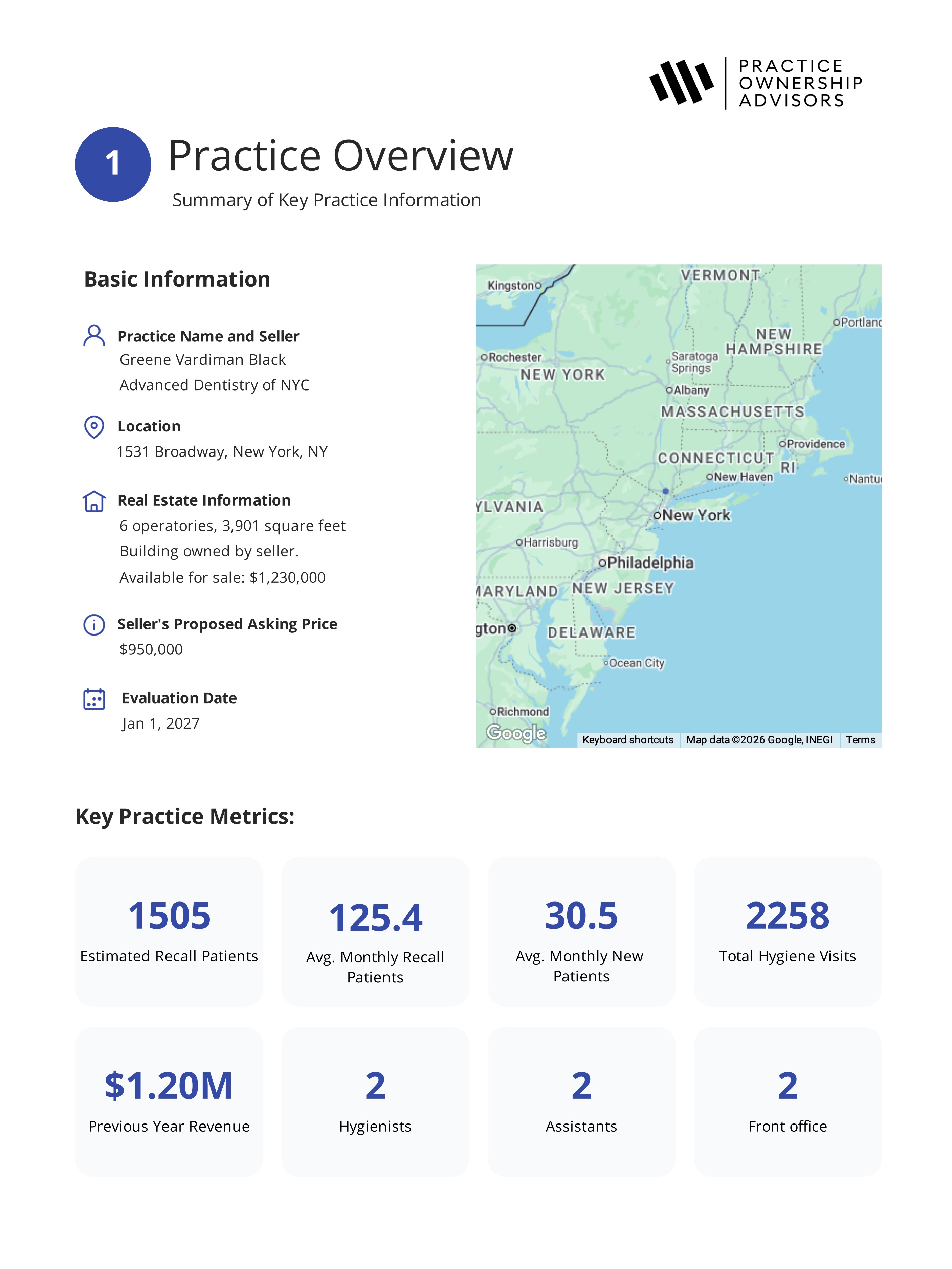
The full breakdown is on YouTube, including ChatGPT's analysis on screen and pages from my evaluation report: This Dentist Made $1.1M His First Year After Buying This Dental Practice.
Practice Evaluation & Advisory Service
Independent clinical and financial analysis to help you make an informed decision before you buy.
Learn more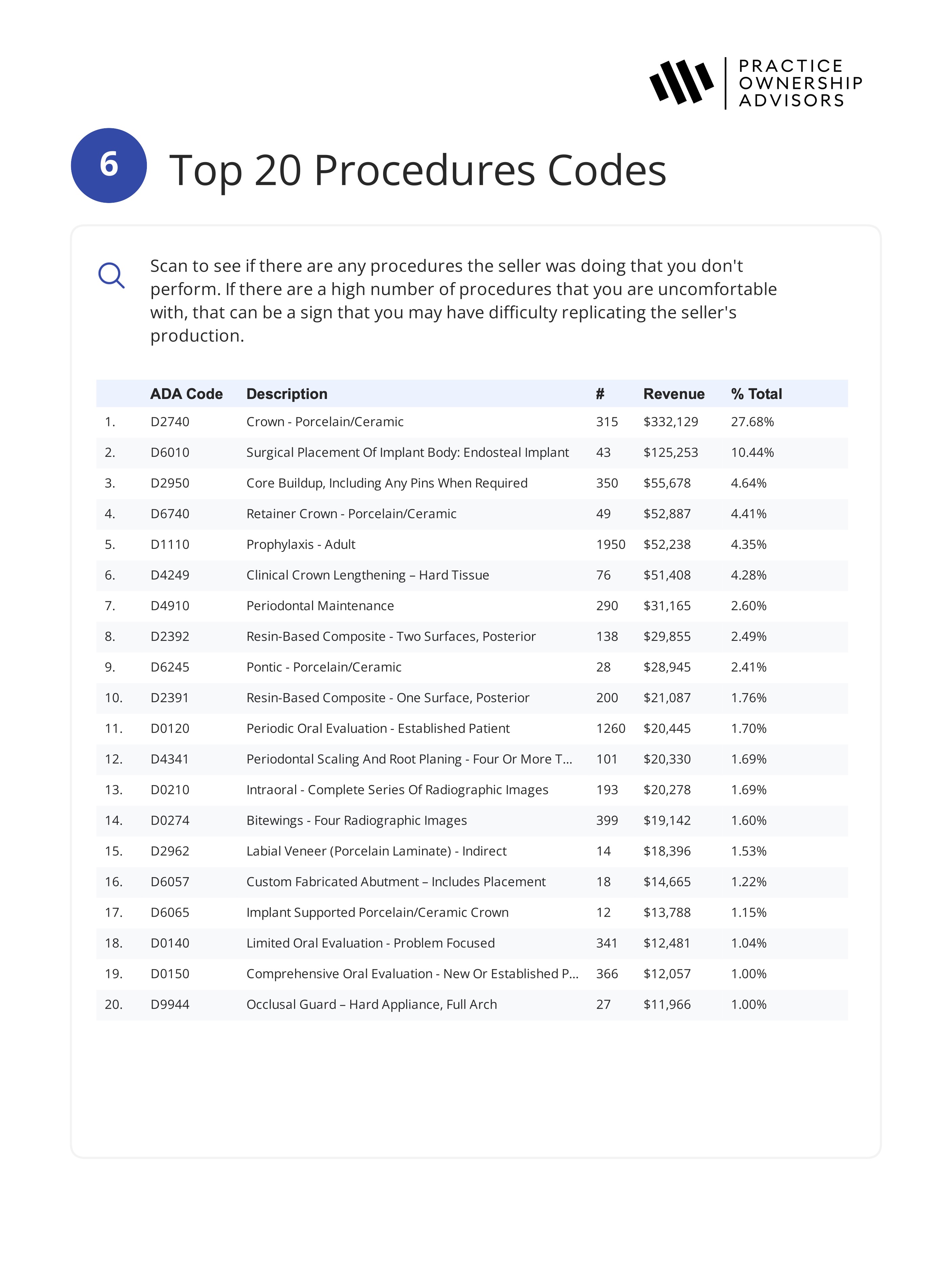
Newsletter + Free Practice Evaluation Checklist
One useful email per week on buying the right practice, plus an instant download of our free Practice Evaluation Checklist.
One email per week. Checklist delivered instantly. Unsubscribe anytime.