
Strategy
Why the Most Profitable Practices Are Often the Worst Ones to Buy
 Chris Marshall, DDS6 min read
Why buying a high-revenue dental practice is often a mistake. The counterintuitive truth about practice acquisitions and why revenue per patient matters more than total production.
The practice doing $2.5 million in annual revenue with the beautiful bank statements and the impressive tax returns? That might actually be a worse buy than the practice doing $900,000.
Here's why.
The Seller Has Already Done All the Work
When you buy a practice generating $2.5 million annually with a well-optimized patient base, you're buying the endpoint. The seller has already extracted the value. They've done the treatments. They've built the systems. They've optimized the schedule.
What you're actually inheriting is a mature revenue model with limited room to grow.
Let me show you what I mean. A practice doing $2.5 million per year with 2,000 active patients is doing $1,250 in revenue per patient annually. That's a fully treated patient base. Those patients have had their crowns, their implants, their complex perio. The seller has done the dentistry.
When you take over, what's your growth strategy? You already have nearly every treatment done. You're looking at 5-10% annual growth if you're lucky and aggressive about case acceptance. That's assuming the same patient base stays, that recall rates don't drop, and that you can actually implement your clinical skills.
It's common for new owners of high-production practices to see revenue flatline or decline in the first two years. The practice has already been optimized. There's limited room to move the needle.
The "Bad Looking" Practice Is Often the Best Deal
Now let me tell you about the practice doing $900,000 annually with 1,500 active recall patients. On the surface, this looks mediocre. The P&L doesn't jump off the page. The broker is probably apologizing for the numbers.
But look at the revenue per patient: $600 per year. That's untreated dentistry. That's potential.
That same patient base could generate $1.5 to $2 million if it were optimized. Why? Because there's room to grow. There's decay waiting to be treated. There's perio that hasn't been addressed. There are patients who need crowns and they're still coming to recall appointments, they just haven't had the work done yet.
This is the practice I want to buy. This is where your income growth comes from. You're not buying someone else's fully extracted model. You're buying an opportunity.
Declining Revenue Can Actually Be Good
Here's another one that makes brokers uncomfortable. A practice with declining revenue can be a fantastic opportunity if the right things are stable.
Let's say you're looking at a practice doing $1.1 million now but $1.3 million five years ago. Revenue has declined. That's usually presented as a red flag. "The dentist is slowing down," the broker will say apologetically.
But what if you dig deeper? What if the hygiene revenue is steady? What if the patient base is still 1,600 active patients? What if the reason for the decline is that the dentist simply didn't want to do complex cases anymore?
That's not a problem. That's an opportunity. The patients are still there. The revenue base is still there. You're just going to take a different approach to treatment planning.
I've had buyers nervous about practices in slight decline. Then they bought them, adjusted their approach, and grew revenue 30-40% in the first two years. Why? Because they weren't dealing with a brand-new patient acquisition problem. They were dealing with a clinical opportunity within an established patient base.
Revenue Per Patient Is the Most Important Number
This is what I focus on above everything else. Not total revenue. Not total net income. Revenue per patient.
Here's why: it tells you how much dentistry is left on the table.
A practice with $800 per patient in revenue has way more growth potential than a practice with $1,500 per patient. It doesn't matter if the second practice has a higher absolute revenue. It's already been picked clean.
When I'm evaluating practices for buyers, here's what I'm looking for:
- $600-$900 revenue per patient is ideal (plenty of opportunity)
- $900-$1,200 is solid (still some room to grow)
- $1,200-$1,500 is mature (growth will be modest)
- $1,500+ is extracted (you're buying at peak, growth is limited)
This metric alone explains why some of the "worst looking" practices end up being the best acquisitions.
The Real Risk Is Overpaying for a Borrowed Model
The biggest risk of buying a high-revenue practice is that you overpay for someone else's success. You pay top dollar for what they've built, then you discover that you can't maintain it or grow it much further.
I've watched dentists pay $800,000 for a $1.8 million practice and then watch revenue decline to $1.5 million within 18 months. They overpaid because they looked at the total revenue and assumed they could maintain it. Turns out, the dentist was doing complex cases that the new owner wasn't interested in. Or wasn't skilled at. Or couldn't replicate because the team changed.
But if you buy a $900,000 practice for $400,000 and grow it to $1.4 million? You're looking at a 50% return on your investment in addition to your income from year one.
What I Actually Recommend
When I'm working with buyers, I'm looking for:
- A patient base of 1,200 to 1,800 active patients
- Revenue per patient of $600 to $900
- A stable hygiene program (the real foundation of growth)
- A team that's been there for multiple years
- Modest total revenue ($800,000 to $1.2 million)
This profile usually gets overlooked by buyers looking at brokers' glossy presentations. It's not impressive on the surface. It doesn't make you feel like you're buying something successful.
But it's profitable. It's growable. It's not borrowed. It's actually yours to build on.
The practice doing $2.5 million might feel better when you first buy it. You're running a "big" practice right away. But after two years when you realize you've plateaued and you can't grow much further, you'll start wondering why you didn't buy something with more room to move.
That's the difference between buying revenue and buying opportunity.
Choose the opportunity. The revenue will follow.

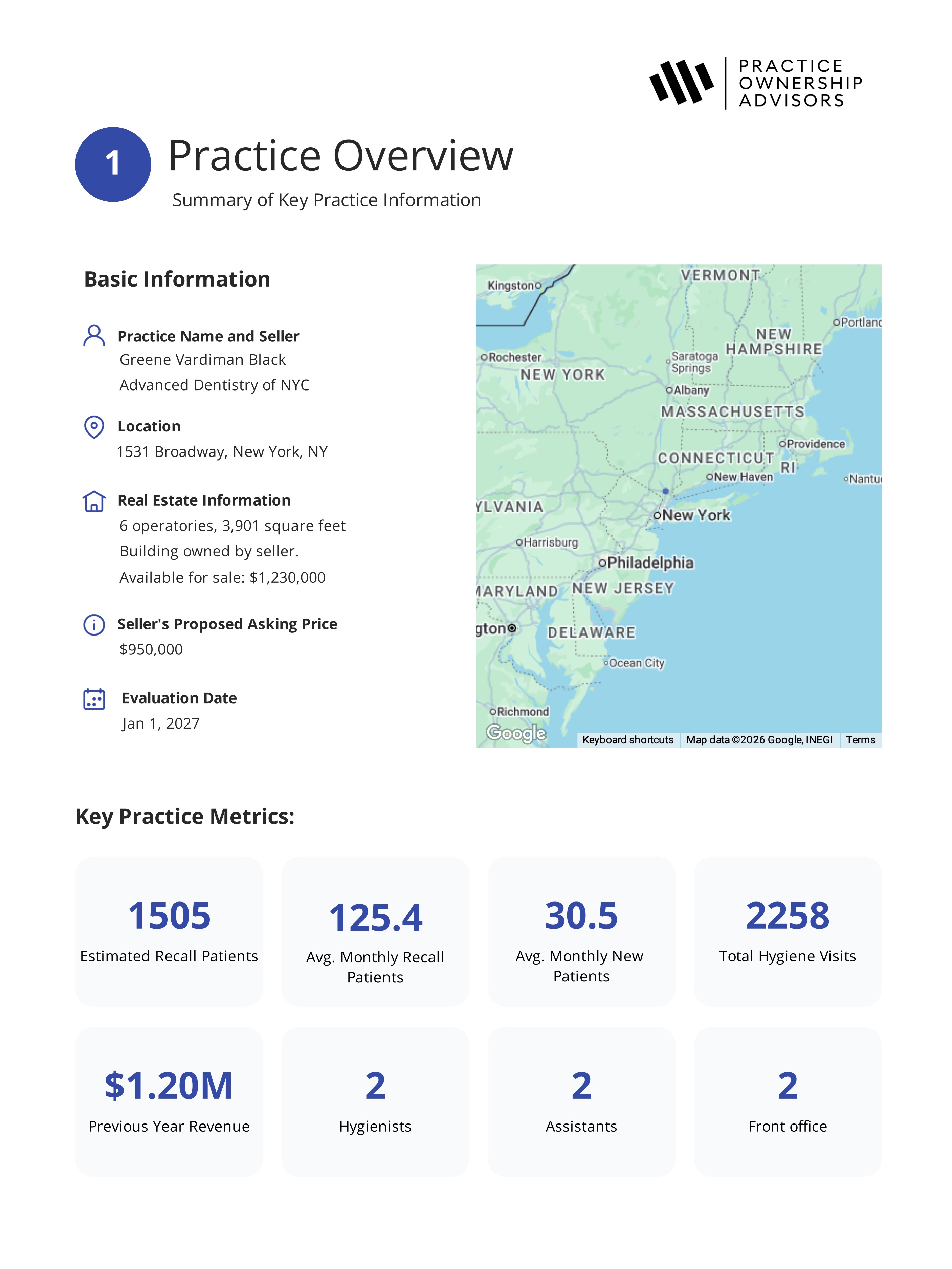
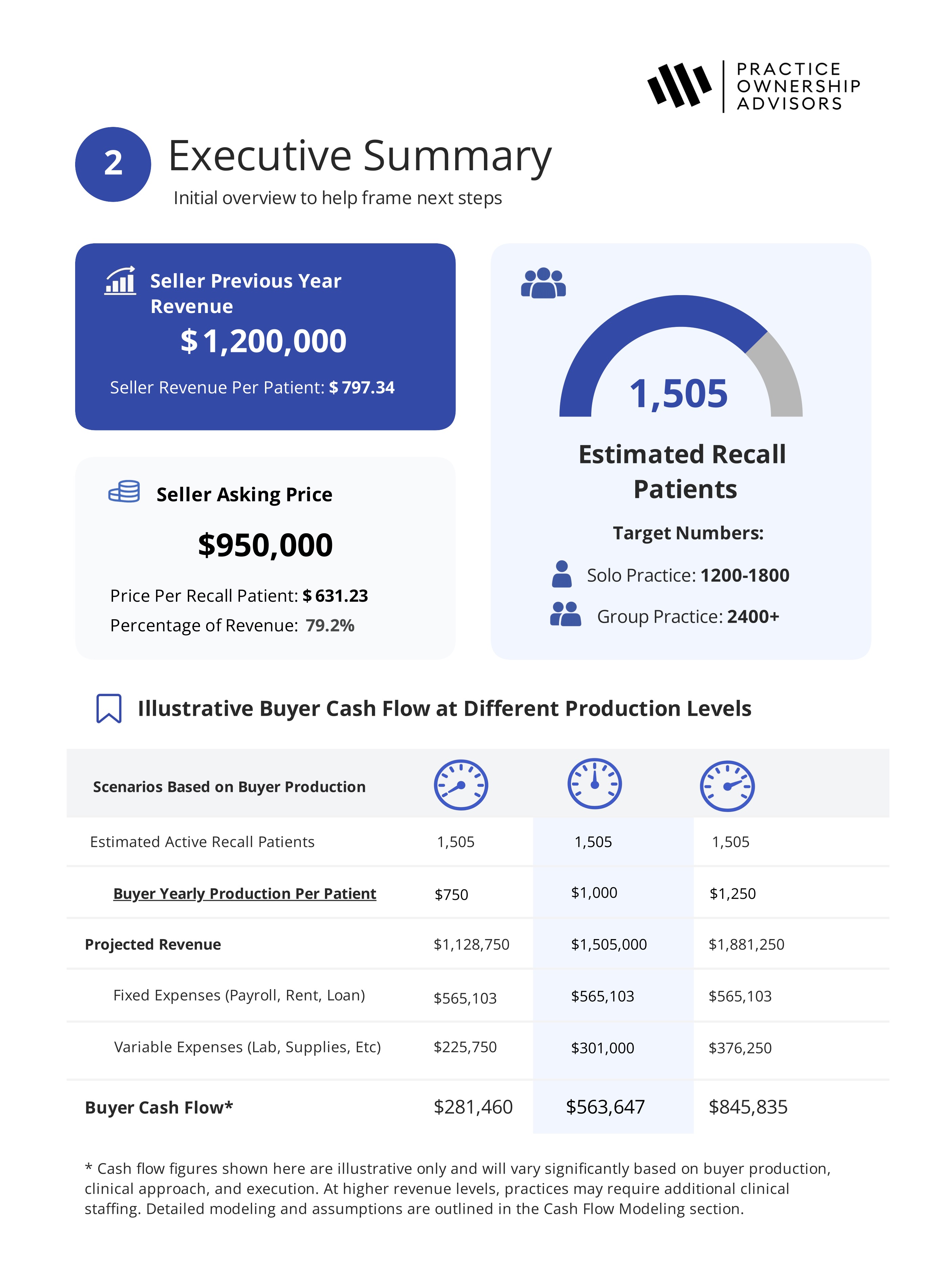
Practice Evaluation & Advisory Service
Independent clinical and financial analysis to help you make an informed decision before you buy.
Learn more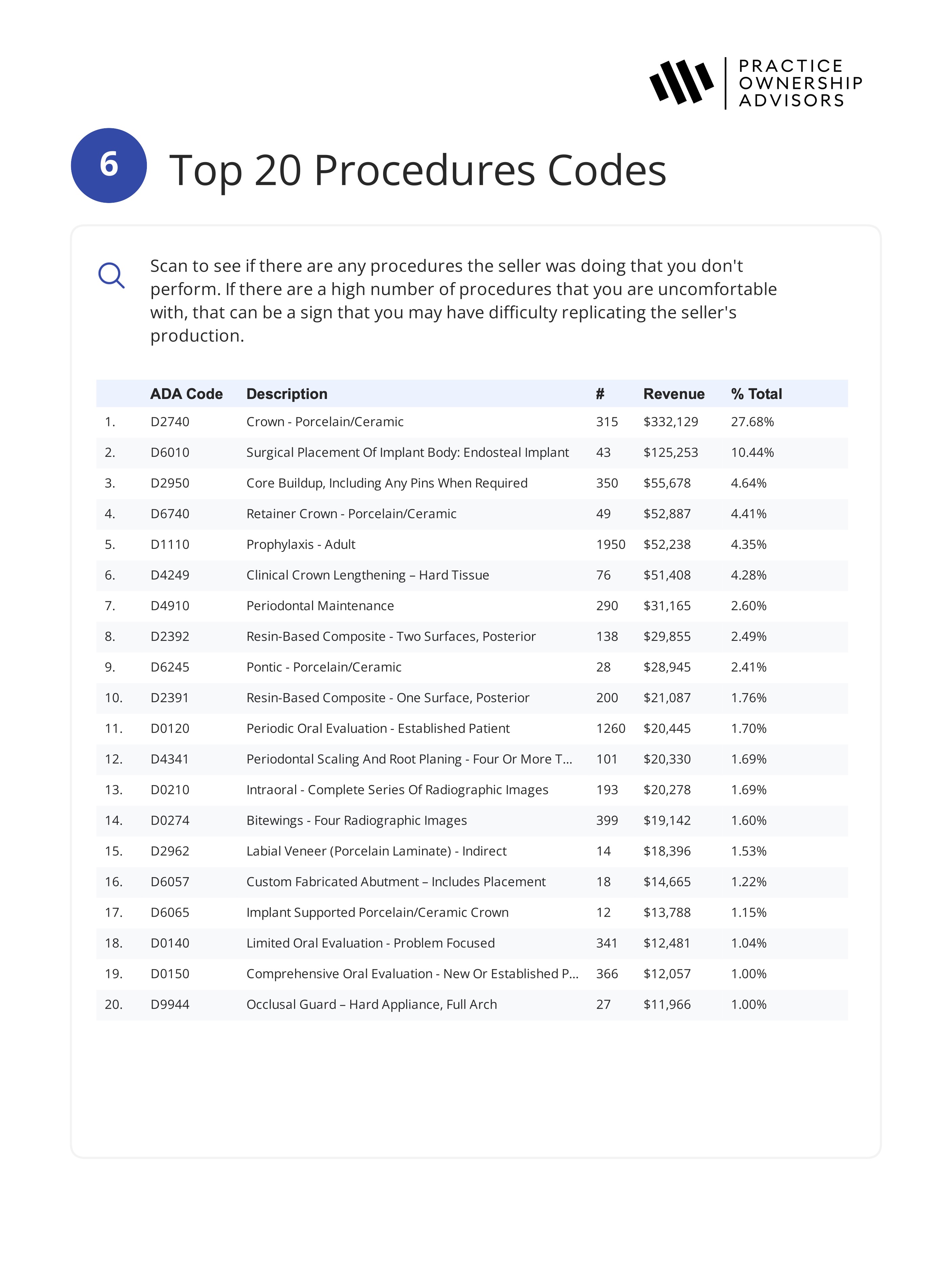
Newsletter + Free Practice Evaluation Checklist
One useful email per week on buying the right practice, plus an instant download of our free Practice Evaluation Checklist.
One email per week. Checklist delivered instantly. Unsubscribe anytime.